Sitting Firmly in Place
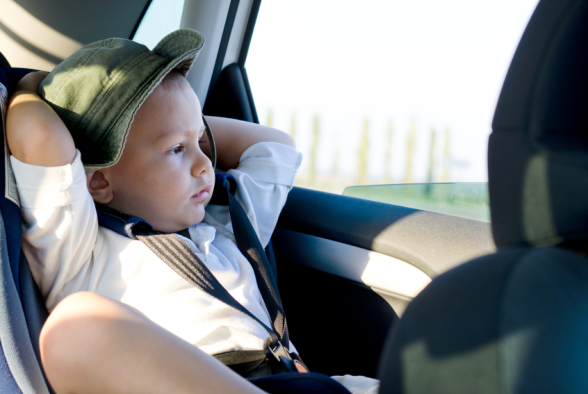 We spend a lot of time driving from one place to another. Please make sure your kids are safely contained within your vehicle. Know who should be sitting where and in what. Car seats and restraints save lives. Be informed and prepared. It could make all the difference. Each year thousands of young children are killed or injured in car crashes. Proper use of car safety seats can reduce traffic fatalities by at least 80%.
Within the GPM race car, Dr. Mark is surrounded by a roll cage made of steel tubing. It protects him from the impact of other cars, the wall or if the car flips onto its side or top. He is contained by a racing seat and harness that is similar to a child’s car seat with added protection to his head, neck, shoulder, rib and leg areas. Read below to learn how to best protect your child in the event of a car accident.
Choosing the Right Car Seat and Restraint
Choosing a car seat that is right for your child depends on your child’s age and size, and how it fits into your vehicle. Before you buy a car safety seat, look at several different models. Make sure that the car seat will fit in your car and that your seat belts will work with the seat. Remember that with each transition, there is a loss of some safety – so use the restraint to the highest weight and height limits allowed. There are several types of car safety seats:
- Infant-only seats:
These are rear-facing only seats. They can be used from birth until a child weighs approximately 20 pounds (depending on the model). They are small and portable.Some of these seats come with a detachable base. You attach the base to the seat of the car. This allows you to easily snap the car seat in and out of the car without re-installing the car seat each time. - Convertible safety seats:
These seats can be used in both rear- and forward-facing positions. The seat needs to stay in the rear-facing position until your child is over 2 years old and has reached the highest weight allowed for the rear-facing position (usually about 30 pounds, but may be more or less depending on the car seat). They can be used in the forward-facing position to a much higher weight limit. Continue using a five point harness to restrain your child for as long as possible, as they are superior to a lap/shoulder belt. - Combination seats:
These seats are forward-facing seats that can be used after your child has reached the maximum rear-facing weight limit and is at least 2 years old. Your child must wear the 5-point harness until he or she has reached the maximum weight limit. Remember that a five point harness offers superior protection over a lap/shoulder belt. When your child reaches the harness weight limit, you can use this seat as a booster seat by correctly positioning the car’s lap/shoulder belt across your child. It can be used as a booster seat to a certain weight limit printed on the seat. - Booster seats:
These are forward-facing seats that lift the child higher so your car’s lap/shoulder belt will fit correctly over the child. A booster seat is for children over 40 pounds. It should be used until the child is 56 inches tall, a height usually reached between 9 and 12 years of age. If the seat in your vehicle has no headrest, then you need a high-back booster seat. Placing your child in a seat without a headrest is unsafe. - Built-in seats (integrated seats):
Some cars and vans come with built-in child safety seats. These may be used by children who are over 2 years of age, weigh at least 30 pounds and meet the weight and height requirements specified by the manufacturer. Check with the maker of the car to find out the specific height and weight requirements.Keep car seat instructions in a safe spot, such as taped to the back of the seat. Send product information to the manufacturer to make sure you are notified of any safety recalls. Write to the manufacturer if you need a new instruction manual.
Where Should the Car Seat Be Placed?
- Whenever possible and at any age, put the safety seat in the back seat of the car, which is much safer than the front seat.
- Air bags are standard equipment in most new cars. They have saved many lives. However, they are very hazardous to infants and children. They have caused death from brain injury. If your car has air bags, take the following precautions:
-
- Infants riding in REAR-facing child safety seats should NEVER be placed in the front seat of a car or truck with a passenger-side air bag. They must be in the car’s rear seat or not ride in that vehicle.
- Children in FORWARD-facing child safety seats should also ride in a car’s rear seat until 13 years of age.
- If the vehicle does not have a rear seat, children riding in the front seat should be positioned as far back as possible from the air bag. Move the seat all the way back so that the child is as far as possible from the dashboard. Consider using a five point harness to help keep the child away from the airbag in case of a collision. Some cars come with air bag ON/OFF switches. Turn the air bag off only if your car has no back seat.
- Side air bags improve safety for adults in side impact crashes. However, children who are seated near a side air bag may be at risk for serious injury. Read your vehicle owner’s manual and your car seat manual to find out how this applies to your vehicle.
When Can My Child Use a Regular Seat Belt?
Keep your child in a booster seat as long as possible. Your child could be ready for a regular seat belt anywhere between 9 and 12 years old depending on height and weight. Your child should be about 4′ 9″ tall and at least 60 to 80 pounds to properly fit an adult seat belt. When your child is ready for a regular seat belt, use a lap belt low across the thighs. If your child is using a shoulder belt, it should cross your child’s chest, not the neck or throat. Never put the shoulder belt under both arms or behind the back.
In summary, your child is ready to ride in a car using the lap and shoulder belt when:
- The shoulder belt fits snuggly across the center of the shoulder
- The lap belt fits low across upper thighs
- The knees bend over the seat while sitting as far back as possible without slouching
Get It Checked
Now that you have the information you need to choose the right car seat, please make sure you have it installed correctly. Follow the link below and enter your state and zip code to find out where you can have your car seat installation checked free of charge.
For additional questions, call toll-free at 866-SEATCHECK (866-732-8243).
Be a Good Role Model
Your kids are watching you! You need to set the lead by putting your seat belt on each and every time you get behind the wheel. If you make it a habit, so will your kids!
Parent Resources
- Parents Guide To Playing It Safe
- Car Safety Seats for Infants and Children
- Car Safety Seats for Infants & Children (Illustrations)
- Car Safety: Children Over 1 Year Old
- Car Safety: Infants
Source:
Written by Barton D. Schmitt, MD, author of “My Child Is Sick”, American Academy of Pediatrics Books.
Published by RelayHealth.